
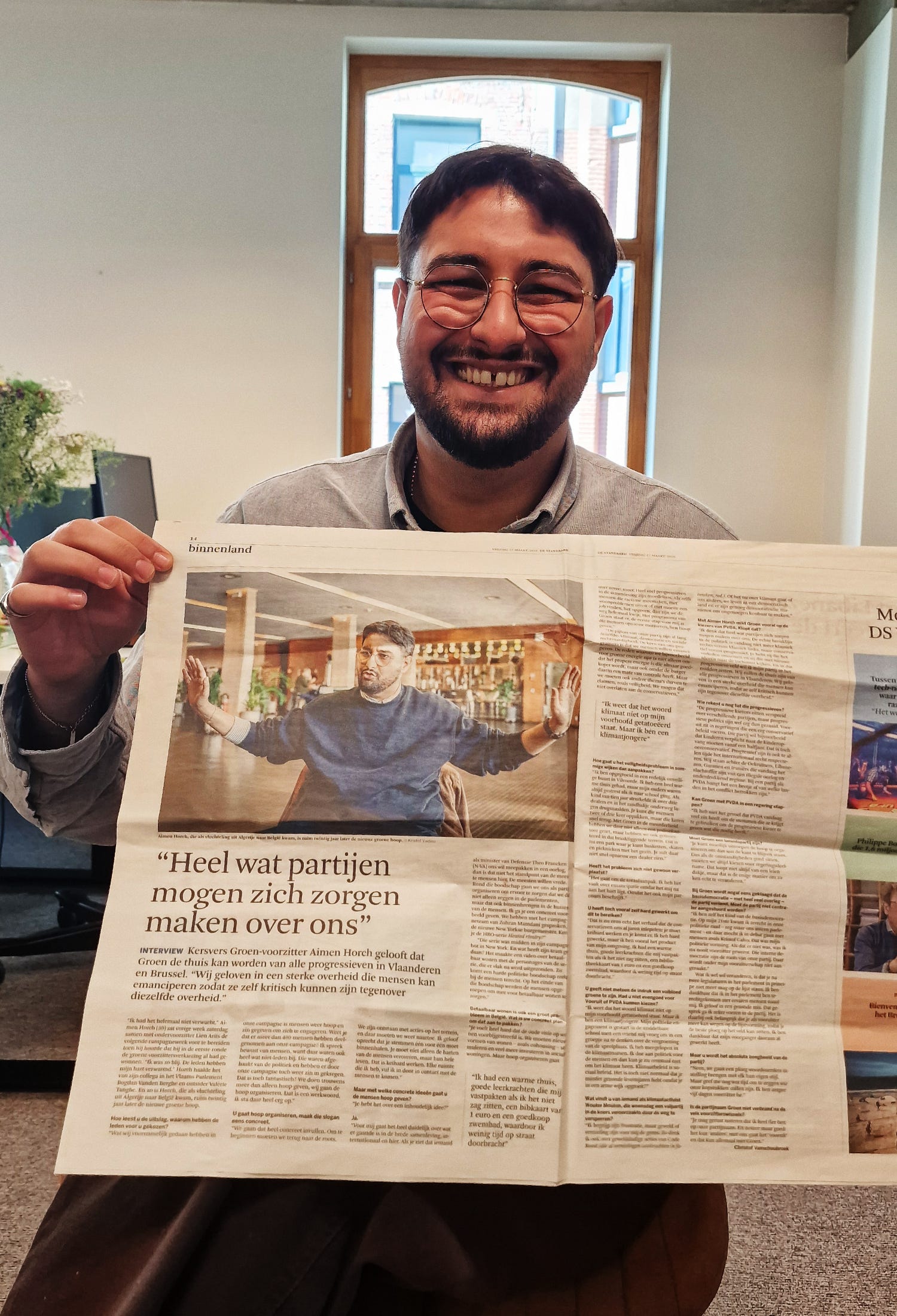
Aimen Horch until recently was mostly unknown in the Belgian political scene, yet at the end of last month he pulled a surprise and won the leadership contest for the Flemish Green party – Groen – with an absolute majority in the first round, against a more well-known establishment candidate, with a campaign focusing on “hope”, and he himself recognises, inspired by the likes of Zohran Mamdani in New York City and Zack Polanski in England.
Today he gives his first international interview, to Hexagon.
[full transcript below]
In 1991 an Islamist party won the first round of the Algerian parliamentary elections, and in response the army staged a coup d’état to seize power and stop the creation of a theocratic state. The result was a bloody civil war that lasted more than a decade.
In the middle was Aimen Horch and his family, who fled Algeria’s second city to a Brussels suburb. That suburb was Vilvoorde, which at the height of ISIS (or Daesh) was its favourite hunting ground in Europe for radicalized young men to join its army. “It was happening around us. One day you’re talking with somebody you just met [...] and then before you know it [they] take the first ticket away to Syria”, Horch recalls. The solution was a society-wide deradicalization program which included everyone: “We actually took in the Muslim community as part of the deradicalization program. So [everyone] worked with the police, they worked with local authorities, they worked with secret services, with [the] army”.
Now, Horch just won the leadership contest for Groen, Belgium’s Dutch-speaking Green Party. And he won with an absolute majority against two more centrist establishment candidates. At 30 years old he is Groen’s hope to recover ground after the deep losses of 2024.
‘We are in an energy crisis because of Trump but also because of our dependency on oil and gas’
With Trump’s war in the Middle East raising energy prices, Horch focuses on breaking the oil-addiction. “The countries who are least dependent on oil and gas [...] feel the energy crisis the least”, says Horch. Back in 1999 the Greens in Belgium joined government for the first time and one of the key policy wins was nuclear phase-out, something right-wing parties keep attacking them on. But for the new party leader nuclear is not the solution: “we had seven nuclear plants in the last crisis, we had seven nuclear plants in the crisis before that, and it didn’t change anything”.
On defence the key is Europe First. The American nuclear umbrella has got to go, but Europe needs an alternative. French nukes in Belgium? “I am anti-nuclear weapons [..] but in the current context, with the crazy Putin and the crazy Trump, if we want to have nuclear weapons in this country, maybe they should be European”. Buying American fighter jets? “It’s stupid. [...] [L]et’s go for the European solution. Even if it’s not the best, we’ll make sure it becomes the best by investing in it”.
“In my party there will be zero room for antisemitism”
His first week in office was marked by a first controversy, over an old tweet where Horch had written “Fuck Israel”. He stands by it, but without the f-word, and if he was Prime Minister would treat Israel like Belgium treated apartheid South Africa. Faced with accusations of antisemitism, he’s clear that in his party there won’t be any allowance for any type of hatred, including antisemitism, and that conflating Jews with Israel helps no one, especially not Palestinians.
‘I’m not Belgian Polanski, I’m Belgian Aimen. If I could be the Belgian Zohran Mamdani, I would say yes”
England’s Zack Polanski who has brought the Greens to fight to be the country’s biggest party has Aimen Horch’s attention: “I love Zack. I look forward to meeting him and to work with him”. But he also admires Spain’s Pedro Sánchez and Denmark’s Green-Left SF.
“I’m a republican by reason and monarchist by heart”
Pragmatism above all. Belgium’s linguistic conflict doesn’t really faze the bilingual new leader of Groen, and for him the Greens are Belgium’s most Belgian party working across the linguistic border while respecting the differences. For 2029 he hopes to bring back 2019’s Green wave and mobilize the country in a wave of hope.

Full Transcript
Aimen Horch, thank you for sharing your time
Thank you.
Let’s start with your younger years. Where did you grow up? What kind of environment was that? How was the life of young Aimen?
I had like a double youth, basically, part of it was in Algeria until I was six, and part of it was in Belgium, here around Brussels. I grew up in Algeria in a relatively cozy household with two parents who worked quite hard. My father came out of poverty, worked very hard, and we had a good life to be honest. He had a good job. My mom was a teacher,
and we fled because of war. We didn’t really flee because of economic issues or anything, which makes me in a lot of ways a privileged refugee. Some would say an expat, but that was not really the reality of it. We were refugees, but in certain ways privileged.
I grew up in Vilvoorde, around Brussels, in a harsher context. One of the poorest cities in Flanders, in the middle of a radicalization wave when a lot of young Muslim men radicalized and decided to go to Syria to fight with ISIS. Some of them were people I grew up with that I know personally – or I knew personally. So it’s a very different context. Not a lot of public services. Nothing for the youth. We are the youngest city in Flanders – younger than Antwerp, younger than Ghent. But we had zero for the youth. So the only place you could hang out was the street corner with everything that comes with that.
Vilvoorde was known as the most radicalized city in Europe. It was the city where more per capita young kids went to fight for Daesh in Iraq and Syria. How did you see that as a young man, and how did it change since then?
It changed a lot, and the way it happened was also crazy. Because, you know, youth – people like me – we were not in the boardrooms talking about the issue coming up. We didn’t know about it, right? So it was happening around us. But one day, you’re talking with somebody you just met around the corner in Vilvoorde in the city center, and they start saying the craziest stuff about religion. Things that the people that he was talking with – me and other Muslim guys – were really shocked about like “whoa this is not the way we look at people or how we want to behave with them”. And there was no way to make them reason, in a certain way, or calm them down. That type of stuff starts happening more, and more, and more. You see people you don’t know hanging out with your friends under the bridge in Vilvoorde. And you think “who are these people with long beards talking about Islam?” and they never talk about the radical stuff, right? They always talk about nice stuff in the beginning like “let’s go and search for some food for homeless people and do something with your life, don’t just hang out” and then before you know it, some of them radicalize and take the first ticket away to Syria or to Türkiye to go to Syria.
How did it change the city? In every way possible and imaginable, especially for young Muslim men, but in general for Muslim families and young people in Vilvoorde. Some families broke because they had the same family name as somebody who left. People lost their jobs – a friend of mine lost their job at the airport because you can’t work at the airport anymore [if] your family name is linked to some other guy who did something. There was a stigma around these families. A lot of young people in Vilvoorde started getting, it’s stupid but, they started getting blocked at the entrance of clubs because there’s Vilvoorde on the ID. Stupid things like that and bigger things that created a big complex for a lot of people. And a couple of years later, and I’m part of that generation, you see a lot of young people from Vilvoorde attaining certain positions in society, whether it be on television, writers, choreographers, politicians – we have quite a lot of national politicians from Vilvoorde for such a small city, I think seven or eight for fifty thousand people. It’s quite a lot in Belgium.
That’s the reaction to all of that. That’s a lot of people that at some point decided “okay, let’s change the image of the city, let’s show that there is something more that we can offer than those people who left Belgium for Syria – for Daesh” and that’s what you see today. A lot of young people started to invest in the city. [Yannick] Carrasco, one of the Red Devils, the Belgian national team, he’s from Vilvoorde and invested in a youth sports complex there. Things like that changed the image of the city. But we worked very hard. It is not only politics, but we worked very hard.
Now, if you want to ask more about the political question of how come that today I can say, with a lot of certitude, that radicalization in Vilvoorde is not going to happen that quickly? It’s because the way we as politicians and as members of the city tackled radicalization. The national discourse was very anti-Muslim, very anti-Islam. Which is very stupid, because most Muslims don’t want radicalization, and most victims of islamist terrorism are Muslims. So what we did in Vilvoorde is we actually took in the Muslim community as part of the deradicalization program. So yes, we put in more police. Yes, we put in a police station where people were getting radicalized, absolutely, but we invested in that plain terrain under the bridge where nothing happened. If you go today, you’ll see a basketball court, you’ll see a skate court, you’ll see nature, places where families can go and picnic. Those dealers, those people who went and radicalized the youth, they cannot come there anymore because their family is there, there are young people doing sports there, so there’s no room for them anymore. And we also engage the Muslim community in their radicalization because they understood that it is in their favor to go and work with them. So, the Muslim community worked with the police, they worked with local authorities, they worked with secret services, with whatever army was deployed at that point in Vilvoorde. They gave everything they had, from the smallest imam in the city to a random family who was affected by the situation, everybody worked and made sure that radicalization is just not possible. So the right-wing idea that we’re going to put a police station and then it’s going to get fixed, it’s bullshit. We have police in Vilvoorde, we have more than enough police stations. We invested in the people, and we engaged people who were touched by the situation first, instead of demonizing them, that’s what helped.
There’s quite a big wave of radicalization, especially of young men, and nowadays most radicalized young men are not Muslim, and they are not radicalized on the streets. How can we translate these learnings from this specific context of on-street radicalizations, particularly of Muslim young men, to the more broad radicalization of young men, which happens more online?
The anti-terrorism cell of Belgium wrote a report, a couple of months ago, about the radicalization of young people. More and more young people, especially young men, get radicalized. Part of its religious radicalization – religious, not Islam alone. Islam is a big part of it, you can’t hide that there’s still a problem there. But a lot of its far-right radicalization, and then you have this very new trend of anti-state radicalization. And the red-line between all of them, the thing that connects all of these is a fundamental hatred for women, for minorities, and the idea that these people are coming to replace you. So, Muslim radicals think that gays are going to come and replace them. Far-right radicals think that women and gays are going to come and replace them. It’s the same dynamic and it happens online. A lot of it happens online, people don’t get radicalized on the streets anymore. How do you tackle that? It’s the same recipe but put in a different way.
First thing is to regulate these platforms. We have to understand that Mark Zuckerberg right now is becoming a millionaire, he’s making money on the radicalization of young people because his algorithm is pushing radicalized content. So that’s the first thing we have to do, tackle these companies and make them understand that either they pay for the damages that are done to society, or they stop with the algorithm. Second thing we have to do is to bring back these people within society. The reason why a lot of them, especially young men, radicalize is because they don’t feel well in their body as young men, and because a lot of things that we as progressives said that are true about toxic masculinity, about the patriarchy, are being interpreted in a certain way that is very negative to us and beneficial to the far-right. So if you have to change the discourse, you have to be very upfront about it. One of the most important things for me as president of a party – I’m a young president of a party – is to show what non-toxic masculinity can mean in the context of politics. By being it, not by telling what it is, but by being it. By showing that you can be very comfortable in your skin as a man – I’m a man, I’m very happy to be a man, there’s no problem with that – without having to take the place of women in society, or using the same patriarchal structures that were used in the past to undermine people.
So there’s a lot of work that we have to do as progressives to bring back these men, obviously, and we have to take that very seriously, because in no way will I give half of society to the Right just like that. Just not going to happen. And yes, we have to be critical about ourselves, but we have to, first and foremost, to tackle these structures, these social media structures that make this radicalization possible. It’s a business model, not just a coincidence.
You’re 30 years old. In most countries in Europe, it would be quite a novelty to have such a young party leader. But in Flanders, it seems quite normal: the Flemish Socialist leader was 26 when he took power, the Flemish far-right leader was 28 and the Flemish Christian Democrat was 33. Do you see your age as an issue at all?
Here and there, but it’s not an issue anymore. I think my background, the fact that I was a migrant is more of, not an issue, but more of a story today than my age, to be honest.
You were recently elected as leader of the Flemish Greens in the first round against two more centrist status-quo candidates and with historical turnout for leadership elections. Were you surprised by the victory? Was this the plan for all along?
Listen, I was in that room over there when I got the results, and me and my vice-chair Lien [Arits] were preparing the second round. We were literally briefing the campaign for the second round next week when we got the results that we don’t have to do a second round anymore. I was very surprised. I’m not shocked about the result. I’m surprised that so many members went and voted. I am surprised that I got elected in the first round. That is something very special in the party, it doesn’t happen a lot, but I’m not surprised about the results, because when you look at the broader progressives today and what they need, what they are looking for, it is that sparkle of hope, that new energy, the feeling that you can win again, that it is possible, that we don’t have to be afraid by the framing of the right in the far right that we are in the right as well, and that’s the story that we were telling, close to people, close to our ideas and our ideology, but also very proud of what we are doing and who we are.
Belgium, Flanders and Progressive Majorities
Most of the people that are going to read this interview are not from Belgium. So let me make a bit of a provocative summary: Belgium is an extremely divided country. There’s two main languages, and there’s a border halfway through. People in the north and the south consume different media, different TV, different newspapers. They have different political parties, different politicians. Political life is as different between North and South as between two separate countries. We sometimes talk about countries like Bosnia and Herzegovina and Lebanon as very ethnically divided countries, but at least they share the same media, same language. Belgium is also a country where a journalist asked the Prime Minister to sing the national anthem, and he sang the French one. Where the current Prime Minister and the minister of defense refused to say “long live Belgium”, and where a train conductor from Vilvoorde got found guilty for saying a bilingual “Good Morning” to welcome his passengers. My question is, does Belgium have a future? What’s your vision for this country?
All of those things that you name are things that were put in place by separatist politicians to create the sense that this country is divided. But if you look at it from a certain distance, I come from Algeria where there are three or four big language groups, maybe 80 or 90 ethnic groups – 80 or 90 in a country that is what 40-50 million people – maybe four times, five times more people than here with a surface that is half of West Europe. Come on, there’s worse in the world than Belgium. Yeah, we have different languages. Sometimes we don’t understand each other, sometimes we do. Sometimes we fight over things. Sometimes we think the same about stuff. Italy is also divided between the North and the South. France is also divided between the North and the South, and Spanish people seriously should not start talking because their country is as divided as can be. So I’m very happy that this weird country exists, that I’m a product of this weird country, and I like it that we have two languages here, I like it that we have two media landscapes, I don’t have a problem with that. At least we have only two, some countries have twenty.
And it seems that some of the few things that unite the country are the royal family and football. I will not ask you about football, but Belgium is one of twelve monarchies in Europe. Are you a monarchist?
I’m a republican by reason and monarchist by heart. I don’t believe in heritage as a way of giving power, that’s one of the worst ways that we can organize a society. Thank God that the king doesn’t have a lot of power, so he’s not getting a lot of it. But I also understand that in this very precarious country where there is a big group that wants to divide this country without a plan – without knowing what to do after – like we saw with Brexit, that there is at least one of these symbols that unites us as a country. That’s the King, fries, waffles, Brussels, and the fact that we don’t understand each other. So that’s what connects us.
In the middle of all this division, [the francophone Belgian Green party] Ecolo and Groen are, together with the leftist PTB-PVDA, the only party that in the Belgian Parliament has a common parliamentary group across the linguistic barrier. How do you see this cooperation with Ecolo, the Francophone Green Party, and how much of a Belgian Green project can we have?
For me, it’s the most unique and authentic work relationship this unitary group, because the PTB-PVDA is different. The PTB-PVDA is basically an Antwerp party that puts lists everywhere, but it is run from Antwerp. The leaders of the PTB, historically, are Flemish people from Antwerp. Raoul [Hedebouw] is the first one who is not and he’s also controlled by Antwerp. So it’s not a unitary party in the sense that it’s unitary towards Belgium. It’s a unitary party in the sense that they are Communists and they always have the party fetish. We don’t. We have two different parties – Groen and Ecolo. We work together a lot. We talk with each other. Tonight, I’m going to go on the French-speaking television to have an interview with my colleague from Ecolo, together. So yeah, we have on some points, different positions, and we discuss a lot, we negotiate with each other a lot about positions, especially when it comes to the state and how to organize the state, and the fact that we can come to a compromise, that is the strength of Belgium. It’s not that “you’re not right” or “I’m not right”, it’s that we’re both right and we’re both wrong, and we work both together. So that’s why, for me, it’s authentic. It’s really Belgium. Belgium is not ignoring the differences, is looking at them at face value, grabbing them, trying to fix it and make it more complex.
We already talked about the radicalization of young men, and one of the ways we see this is the growth of the far-right, which has been happening all over Europe, but in Flanders it seems a bit more structural. There has been a strong Flemish far-right since the dark Sunday of 1991 and on top of this, since 2015, the N-VA has radicalized itself. This means that almost half of Flemish votes go to the radical-right. It’s one of the most radical regions in Europe. On the other side, between Socialist, leftists and Greens – more or less progressive each may be – there’s less than one third of the vote. And the Flemish Socialists are deeply embedded in right-wing governments, both in Flanders and at the federal level. How are you going to deal with it? How do you plan to build progressive majorities in this scenario?
Maybe first, just a nuance, but the N-VA is not far-right. There are far-right elements in the N-VA, for sure, Theo Francken [current minister of defence] and other people who have very hard rhetoric and who are running after the far-right. Maybe Theo Francken is like Sarkozy in France. He’s pushing towards the far-right constantly, trying to look for a way to grab these voters. But whatever he does makes the far-right stronger. The reason why the far-right was so strong in 2024 is because of people like Theo Francken who copied their rhetoric and just made them bigger. If Theo Francken copied the Green rhetoric, we might have had 20%. So, no, it’s not all lost. No, Flanders is not completely fascisized and far-right. It’s absolutely not what Flanders is. But yes, we have a big problem with coalition-building in Belgium. The Socialists went to the Right, completely lost the progressive fundamentals and ideology, and the PTB-PVDA has this strategy of being in the opposition forever, so it’s just a lot of work. Still, I understand that. I don’t have all the solutions right now, but I’m thinking about it quite a lot.
How do we make this happen without infighting for the next 20 years? Because what happens right now is us, the Socialists and the Communists – or us, the Social Democrats and the Socialists, let’s say, so that they’re not too angry when I call them Communists – we are basically infighting constantly over the same 20-25% and none of us tries to broaden that spectrum. And then sometimes, the Greens go with the right-wing government or sometimes the Socialists go with the right-wing government. Whatever they do, they [the Right] always has either one of the Left parties who is willing to lose all their voters for them. We can’t accept that. I’m not willing to go in that dynamic anymore.
Would you join a coalition that includes the N-VA?
Yes.
And would you join a coalition that includes the PTB-PVDA?
Yes.
Both together I will not ask, seems quite unlikely.
Quite unlikely. The first is, by the way, more likely than the second.
War, Energy, Nuclear and Defence
The war in the Middle East has put energy prices back at the center of the debate. Germany and Italy have announced plans to burn more coal. Do we need to sacrifice the planet to make life affordable?
It is one of the most ridiculous things in the world to open coal mines, burn more coal and then think that life is going to be more affordable. The reason why we are in an energy crisis is because of the illegal war that Trump is doing, but because of our dependency on oil and gas as well. I mean, the countries who are least dependent on oil and gas, let’s look at Spain and the investment that they did, they feel the energy crisis the least. So the idea that “let’s burn more coal, let’s burn more gas, that’s what’s going to help us in the future to be less dependent of coal and gas” is ridiculous. It’s one of those far-right logics that, I’m sorry, I think I didn’t read enough books to understand it. Very sorry, might be my problem. No, we need to invest in green energy, and we need to make sure that we get out of this gas and oil addiction that European leaders are in.
We have the same here in Belgium, [Prime Minister] Bart De Wever, it took him one week and a half, two weeks of energy crisis, to come up with a beautiful idea of “maybe we should talk again with Putin and buy his cheap gas”. Is that going to make life in Europe better for us to go and buy Putin’s gas, make him richer? No, it’s just going to fuel a war that is today threatening our safety and that of the Ukrainians. So no, the best way looking forward is to work on an affordability agenda and to get out of those crisis after crisis is to get out of gas and oil as quickly as possible.
Belgium decided in 1999, when the Greens were in government, to phase out nuclear energy. Then after 2020 it was Groen that held the Ministry of Energy and there was a decision, after the war in Ukraine, to delay that phase-out for 10 years. Would energy be cheaper today if the Greens hadn’t turned down nuclear energy?
Energy has never been as cheap as before this crisis. Renewable energy is going below zero sometimes. So no, and we also have to understand the argument of the far-right and the right. They don’t want to talk about climate. They’re not interested in that. So what do they talk about? Nuclear power. It’s a big industry, it’s a big lobby. It can bring a lot of voters in, it can bring a lot of attention. So they talk only about it. They never talk about climate. “And if we have seven nuclear plants in Belgium, the climate will be saved”. I have bad news for them: we had seven nuclear plants, we had seven nuclear plants in the last crisis, we had seven nuclear plants in the crisis before that, and it didn’t change anything. So we have to understand the problem is not how many nuclear plants we have. The problem is not, where can we open a coal mine in Europe. The fundamental question is, where does our energy come from? From the strait of Hormuz, from Putin, from an uranium mine in Congo, or from the sun, the sea and the wind. We’re trying to make it come from the sun, the sea and the wind, because it’s the only thing that we can control.
From nuclear energy to nuclear weapons: Belgium has 10 to 15 US nuclear bombs, in Flanders. In 2020 there was a vote in parliament to remove these nukes from Belgium. It was voted down, but Groen voted in favor. Is that still your policy?
Yes. Because these are American weapons, that’s the big issue. So the question of nuclear protection in the middle of a crisis, you have to be realistic about that stuff, right? You need nuclear dissuasion in this position that we are in right now, it would be very stupid to unilaterally bring down the nuclear persuasion. The problem is, is it persuasive when it comes from the US? And who is it persuading? Who is protecting?
Should we move to a French nuclear umbrella?
I know there are talks about that and we’re still looking at how to position ourselves when it comes to that. I’m going to be very honest with you, it’s not an easy issue for us. It’s not an easy issue for me personally as well. I am anti-nuclear weapons. I am for stopping the proliferation, and I feel it’s a very bad thing that the deal went out. We really need a new anti-proliferation deal, but in the current context, with the crazy Putin and the crazy Trump, if we want to have nuclear weapons in this country, maybe they should be European.
Three quick-fire questions about defense: there’s been a debate in Belgium over buying more American F-35 [fighter jets]. Should it?
It’s stupid. But let me quickly add on that: I know what the argument is. The argument is that the Rafale [fighter jet] from France is not as good as the American. I have bad news for you: It will never be as good as the American ones if you don’t invest in it. So if you want to invest in European defense, invest in European material, even if it’s less good than the American one. And by the way, that’s for me a thing for everything: we have a problem with Microsoft when it comes to our security, our safety, and where we give our data. Governments in Europe have Microsoft back-offices. It’s crazy. It’s ridiculous. If you don’t take Chinese ones, if you don’t take Russian ones, why would we take American ones? So even there, let’s go for the European solution. Even if it’s not the best, we’ll make sure it becomes the best by investing in it.
Should we increase military spending?
Today, in Belgium, no. They have 10 billion this year and they don’t even know what to do with it.
Should we continue to give military support, including weapons and ammunition, to Ukraine?
Yes.
Israel, Antisemitism and the F-Word
As soon as you became party leader, there was some controversy over a tweet you did which said, and I quote “Fuck Israel. Fuck the companies that sponsor Eurovision and are on the BDS list”. Do you stand by that tweet? How do you see the controversy around it?
I won’t use the f-word, but I stand by everything else I said there.
Groen and you have been quite vocal and clear about the genocide in Gaza, so I will not ask you about it. But if you were the Belgian Prime Minister today, what would you do regarding Israel?
I would fight tooth and nail to break the economic deals that we have today with Israel, first of all. Second of all, I would make sure that the Israeli state understands that business and money is not the only drive of Europe, that we also look at human rights and international law, and that a genocide and illegal wars is not something we just forget. We severed ties with South Africa. After a long fight of a lot of activists and progressives, we severed our ties and economic ties with apartheid state South Africa. I don’t see any reason for us today to not do the same with Israel.
After the 2016 terrorist attacks in Brussels, there was a big increase in hate crimes against Muslims. Similarly, after the genocide in Gaza, there has been growing antisemitic attacks in Europe. There was a forced conflation between regular Muslim citizens and Islamic terrorists, and now there is a forced conflation between regular Jewish citizens and the State of Israel. There are around thirty thousand Belgian Jews, mostly in Flanders. Antwerp is one of the few cities in Europe that has a very visible community of Jewish population. [interrupts] Some of them were at my wedding. Last month there was an explosion in a synagogue in Liege. In response to that, the government has placed the military in the streets to supposedly protect Jewish places. How do you see the rise of antisemitism? How do you plan to tackle it? And how do you see this militarization as the response to it?
The first thing that we have to make sure is that people understand that being a pro-Palestinian activist, understanding what is happening today in Palestine with regards to Israel, does not give you a freeway to be antisemitic. And being antisemitic, if you’re as stupid as to think that it’s a good thing to be antisemitic, if you say that stuff and do those things – antisemitic stuff – even for the Palestinians is not a good thing. If you don’t care about the dignity of people because they’re Jewish, at least understand that even for the Palestinians it’s a bad thing. It’s the stupidest thing you can do. And please don’t conflate people who fight for a fair world, against apartheid, with people that hate Jews because they’re Jewish. We have a very well documented history of antisemitism in Europe, a very problematic history, and I understand the ramifications of that. So in my party there will be zero room for antisemitism, and especially under my leadership. I have a lot of Jewish friends, a lot of Jewish people around me that I appreciate, that fight with me, that I would never let them get marginalized.
So how do we see it? We see it in the rise of antisemitic hate crimes. We see it in rhetoric that is used online as well. Some videos that – I’m sorry it [makes my skin crawl] – about how people miss Hitler and things like that. That’s the type of stuff that you see online. Again, we have to tackle these social media platforms that make it happen, make it possible to spread this type of misinformation, this type of hatred. Second of all, we have to protect our Jewish citizens, obviously, and I hope we can have the same energy for our Muslim citizens as well, because they also got attacked, but there was no military and a lot of Jewish citizens who get attacked don’t get military protection. It’s only the big institutions that get it. So we have to protect them. We have to make sure that our police and our police forces understand what the ramifications of antisemitism are, and that people, when they go to the police, a police officer can answer in a good way and can help them. And we have to strengthen the laws, because we have to understand that Belgium is one of the few countries that signed the Dublin deal in 2000 that said that we’re going to put an anti-discrimination office in place and we never did it. We have anti-discrimination, anti-hatred, anti-antisemitism laws, but we don’t apply them. Judges don’t know about it. Police officers are not well trained, so we have to invest in that as well, in strengthening the law. There’s a lot of ways to fight antisemitism, and I’m willing to completely go for it in this country.
Polanski, Mamdani, Sánchez and 2029
Internationally what are some current political figures that you admire or take inspiration from?
I have Zack [Polanski, leader of the English and Welsh Greens], obviously.
Everybody says Zack. I love Zack.
Are you the Belgian Polanski?
No, I’m the Belgian Aimen. But I look forward to meeting him and to working with him. So yeah, Zack Polanski, for sure. Hannah Spencer, by the way, as well. Come on, that was a revelation, wow. But I’m a big fan of Pedro Sánchez, actually. I think it’s an interesting Prime Minister. I think he shows in a lot of ways what leftist coalitions can do. I don’t think he’s doing everything he can do, to be honest, within the majority, and I know it’s always complicated in Spain, but he’s showing whatever he can do, and he’s showing what the alternative can be for a progressive coalition in Europe with the strongest, one of the strongest, growing economies right now. It’s quite a good argument. I’m very interested and I look forward to people, not especially to people that think the same as me, or go in the same way, but people who decided a way, decided the lane, and are very good with it.
That’s what I think is interesting with the Danish Greens [SF] and what they are doing. It’s not the way that we are going with Groen in Belgium, but it’s interesting to see how strong they are in what they are doing, and how they were able to make this big governmental Socialist Party afraid during the elections, really afraid for their seats. So with a good alternative and a good story, not 100% my story, but an interesting one.
So yeah, there’s a lot of examples. Zohran Mamdani. Yeah. If I could be the Belgian Zohran Mamdani, I would say yes.
The English strategy of Zack Polanski has, on one side, according to the latest polling, reached 20% of voting intentions and positioned itself as the clearest alternative to a far-right government. On the other side, there’s been some polling showing that more Green voters support drilling for oil in the North Sea than oppose it and also fracking has quite a big support among Green voters. Both when the Greens go left or when they go centrist, there seems to be a debate about sacrificing core policies. What are, for you, the policy areas that you will not budge for the sake of growth?
For me, it’s a question of health. That’s the fundamental aspect, because you can resume a lot of power dynamics to health. We can talk about, do we choose drilling or do we choose the health of nature and of the people around it. But it’s a power dynamic. It’s a political choice that you make. So in these power dynamics, I’ll never sacrifice on health. I can compromise, we can have discussions, we can have debates. I was in a majority before at local level, we were in a majority at the national level. So I don’t have a problem with that, but I’m not going to just give it up. And yeah, drilling, fracking, those are red lines for me, and I think my voters know that. And a lot of voters, and that’s interesting, might be for fracking but it’s just not their number one priority. And maybe health, environment, social issues, public services are the number one priority of these people.
You’re leading Groen into 2029 when there are European, federal and regional elections in Belgium. Groen got 8% in the last elections, and polls until now have shown it stagnant around that. What are your goals for 2029?
There’s very smart people around me who told me not to pin myself on a number in public. So I’m not going to pin myself on a number, but I do have a good idea of what type of campaign I want to run. And to be honest, in this society where the Right is strong we need to bring a little bit of hope and movement on the progressive side. So if I’m able to run a campaign that looks like the Green wave of 2019 with a lot of people on the streets, a lot of people who are fed up with the Right, with the far-right, and who want a progressive future, and I can show that to this country, that we are with a lot and we have a lot of energy, I would be super happy. And whatever the result that will be, will be a good result to finish.
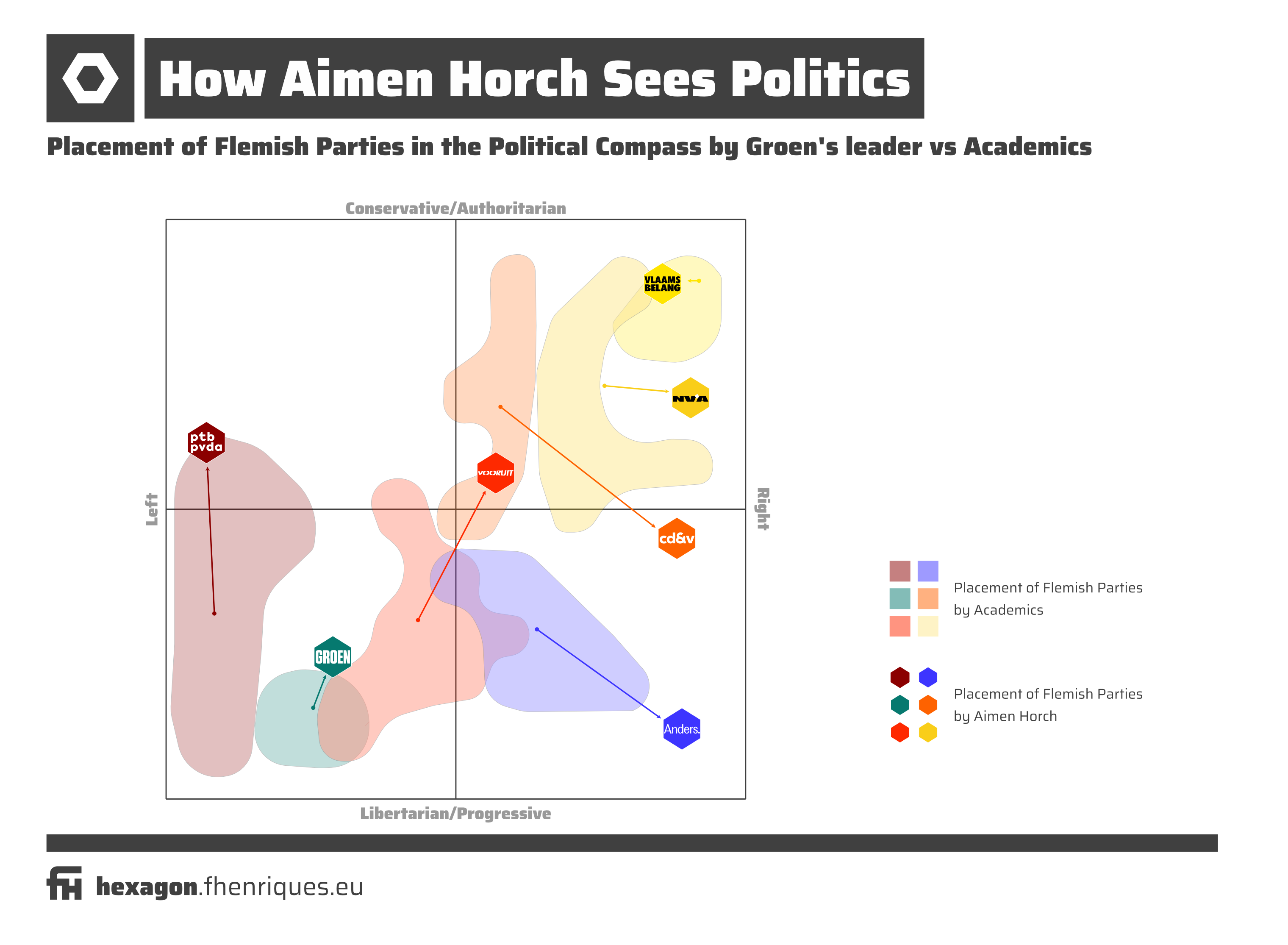
To end this interview, I have a challenge for you. I have here a political compass and I want you to place Groen, and also the other Flemish parties, so we see how you see the Flemish party-system.