

Mette Frederiksen has led Denmark since 2019. She led the Danish Social Democratic Party for three national elections, and in two of them they lost votes. Last week, they got their worst result since 1903. Parties to her right got almost 60% of the vote, and the parties to her left got as many votes as she did.
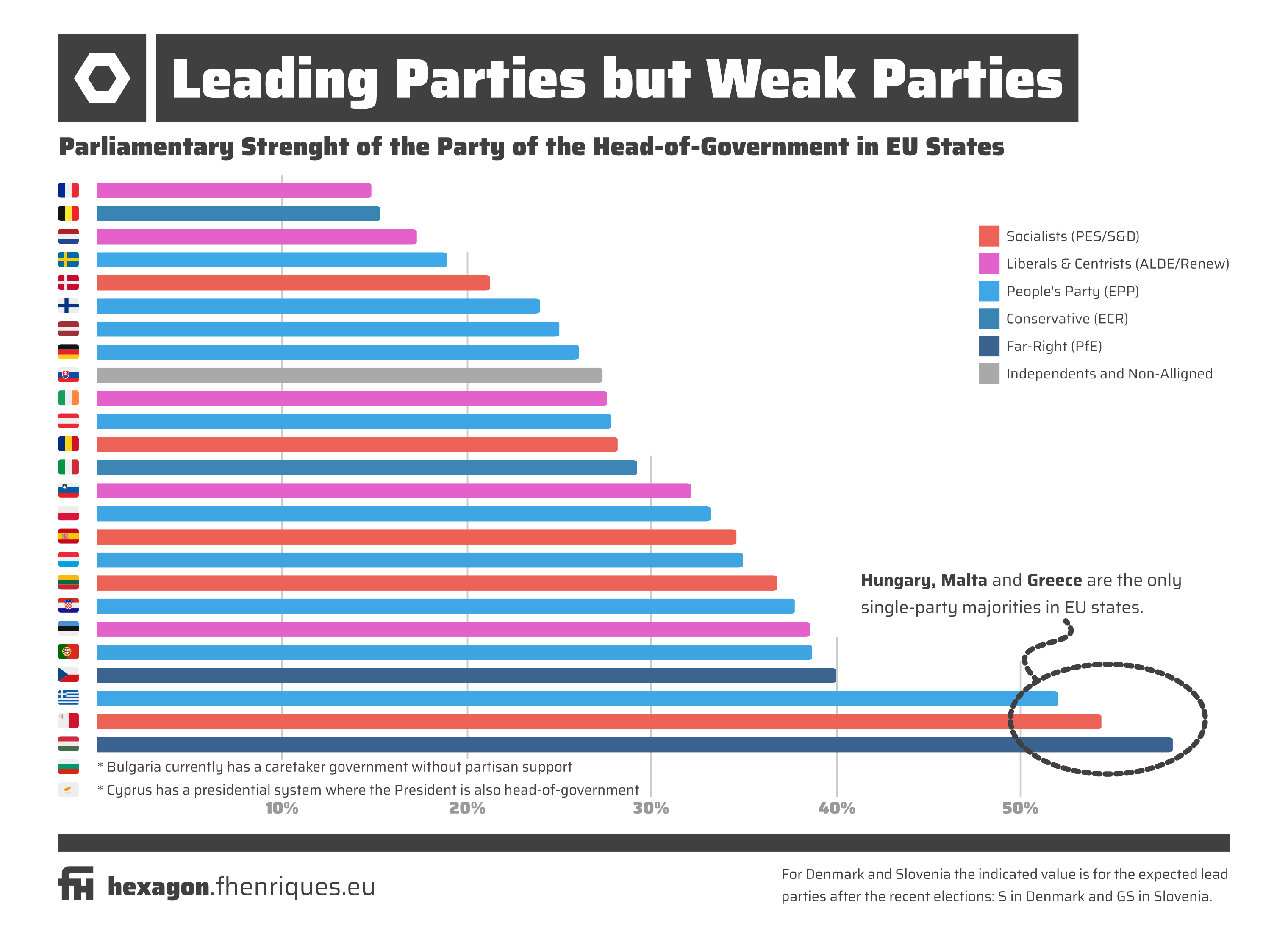
In a European context, Frederiksen’s Social Democrats are heading to be the fifth weakest ruling party in a EU national government. Weaker than them only the parties of Sébastien Lecornu and Rob Jetten in the minority governments of France and the Netherlands, the Flemish nationalists leading ethnically divided Belgium and the complicated Sweden where the third biggest party rules the country with the support of the second-biggest.
The Danish Social Democrats are weak, keep losing and yet they - and Mette Frederiksen - are the undisputable leaders of the country. How? What can possibly explain how such a losing leader can actually be victorious in seemingly keeping power without much hassle?
The decline of Scandinavian Social Democrats
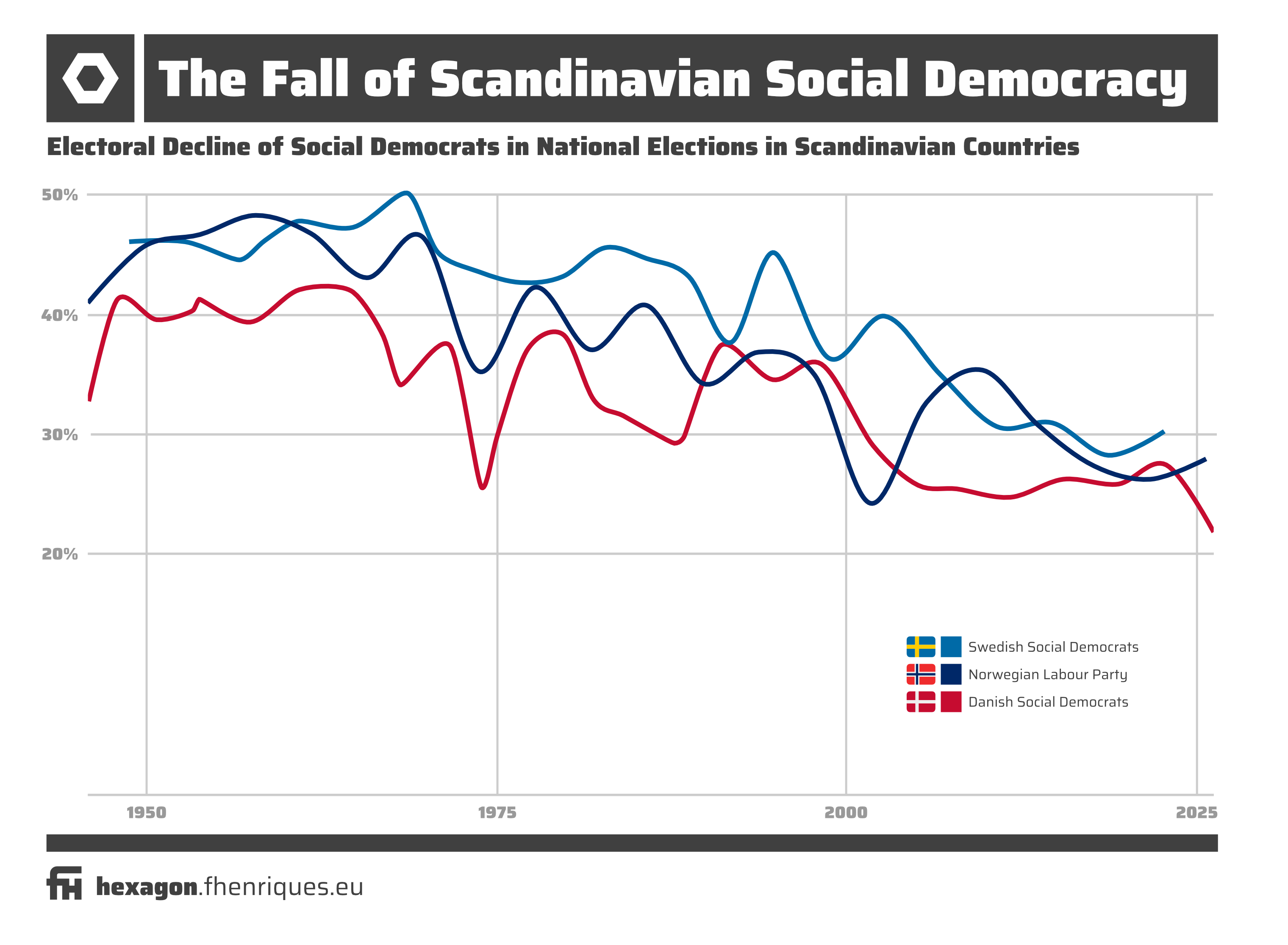
In Scandinavian post-war politics the Social Democrats have been dominant: in Sweden, Denmark and Norway, the Social Democratic parties have always been the biggest party in the country, except for a short period in Denmark from 2001 to 2011. The big change has been their decline: they went from parties capable of fighting for a uniparty majority to parties around 20 to 30% of the vote. The decline has been constant.
While fragmentation of party-systems has been a common trend around Europe, in Scandinavia it’s more obvious as it comes from such a dominant-party situation.
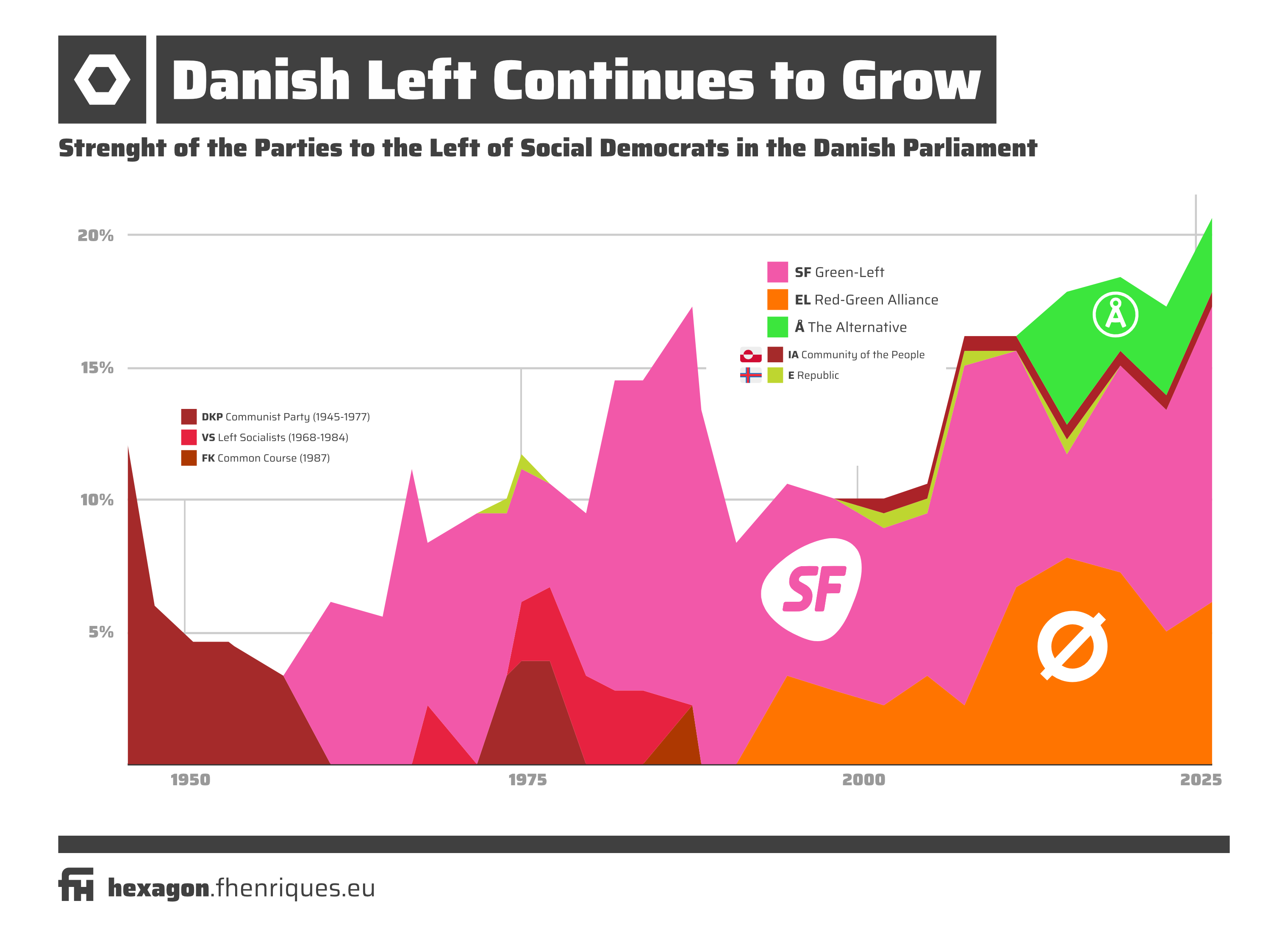
In the case of Denmark, while the Social Democrats have lost ground, the parties that today are part of the red bloc have remained mostly stable. Composed of social-liberals, social democrats, socialists, Greens and leftists, the red bloc is not a fixed or historical entity. The Social-Liberals of the Radikale Venstre have historically been part of the right-wing of politics, and even led a government in the late 1960s. Yet since the 1990s they have stood with the left. To the left of social democracy, the Danish Communist Party was a key part of the anti-Nazi resistance movement and even participated in the first national unity government in 1945, yet was generally kept away from power due to their links to the Soviet Union. When in 1956 Soviet troops invaded Hungary to depose the reformist government of Imre Nagy, this led to a rupture of the Danish Communist Party with Aksel Larsen leading a split and forming the Socialist People’s Party or SF - Socialistisk Folkeparti, today officially translated as Green Left - on the basis of folkesocialisme, an ideologic current of democratic socialism. In 1966 the SF was first part of a governing majority, giving parliamentary support to the Social Democrats in what was called the Røde Kabinet or Red Cabinet.
While the Social Democrats lost ground, the parties of the center and left that have reducing social inequalities in their ideologic basis have kept the progressive camp intact and quite stable close to the 50% barrier.
Centrism is Nothing.
Mette Frederiksen is mostly known abroad, and used abroad, as the example of a leader of the left that “has understood” the growth of the far-right. The Danish Social Democrats have become an outlier not only in the European socialist family but on the left as a whole: their “tough migration stance” (aka anti-immigration racist narratives normalized) are only matched on the left with parties like Slovakia’s authoritarian Smer-SD, Germany’s left-conservative BSW or Czechia’s national-communist KSČM.
After the 2022 elections she took another page of the same book, and despite having a majority to continue the broad left government that she had led since 2019, she decided to create a government based on the three biggest parties. Together with the center-right parties Venstre and Moderaterne, a centrist government was formed, with a majority of ministers from the right-wing of politics, and where Frederiksen’s party felt zero pressure to apply progressive politics.
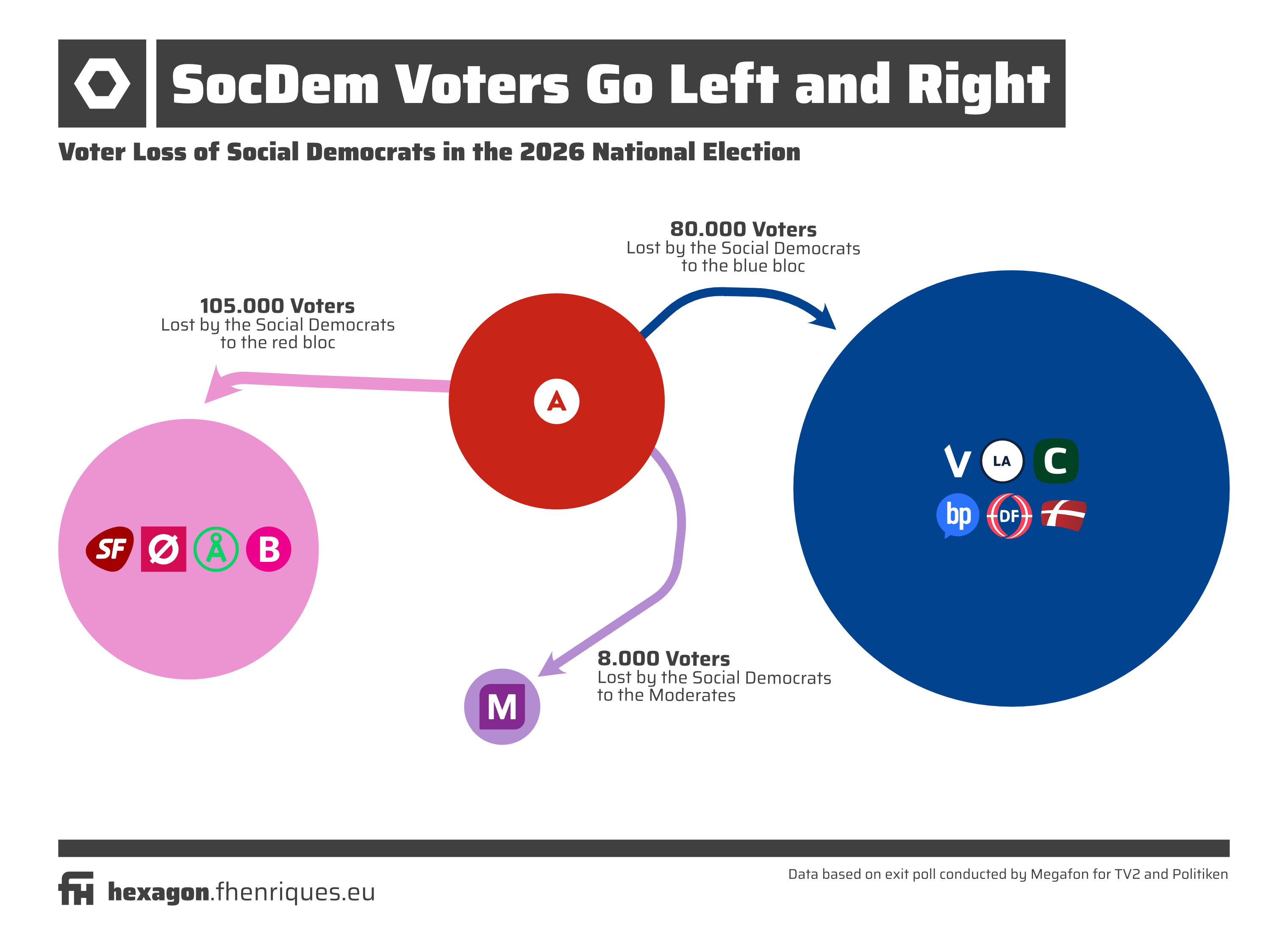
The 2026 election brought the result. The Social Democrats had their worst result in more than 100 years. They lost more than 100 thousand voters to the parties of the Left and almost 90 thousand voters to parties on their right, mostly to their partners of Moderaterne and directly to the far-right. Frederiksen led the Social Democrats to a double bleeding: to her left due to the lack of progressive policies and to her right due to her normalisation of far-right policies.
Social Democrats lead the Left. The Right is Chaos.
So in 2022 Mette Frederiksen broke the majority the Left had gained and built a centrist government, refusing the support of those who had brought her to power four years earlier.
Yet, in the run-up to this election, all other parties on the Left saw Frederiksen as the potential leader of a left-wing government. When asked, the Red-Greens said they weren’t sure about Frederiksen due to her right-wing government, and maybe they preferred SF to lead a new government. SF’s answer was that their bet was for a Frederiksen-led government, not for them - the main opposition party - to challenge her. After the election the Red-Greens had one single demand in return of nominating her to the King: tell the country you prefer a red government to another centrist coalition. All other Left parties did the same.
Meanwhile on the Right, there were five parties with similar vote shares. One of them - Lars Løkke Rasmussen’s Moderaterne - refuses to be seen as a part of the right-wing bloc. Another - the Liberal Alliance - didn’t hide their aim to lead that bloc, instead of the traditional leader Venstre.
On the day of the elections the right-wing parties - including Moderaterne - had a theoretical majority. The far-right Citizens’ Party refused to nominate Venstre’s Lund Poulsen as formateur. Then on March 28th the Citizen’s Party expelled one of its 4 MPs. Later the same day, it was the Liberal Alliance that expelled one of its 16 MPs. The theoretical majority was gone.
The chaos of the right makes it difficult to even think of an alternative government. The unity of the Left makes it the most viable solution. The King nominated Mette Frederiksen as formateur with the condition of forming a government with Green Left SF and the social-liberal Radikale Venstre.