


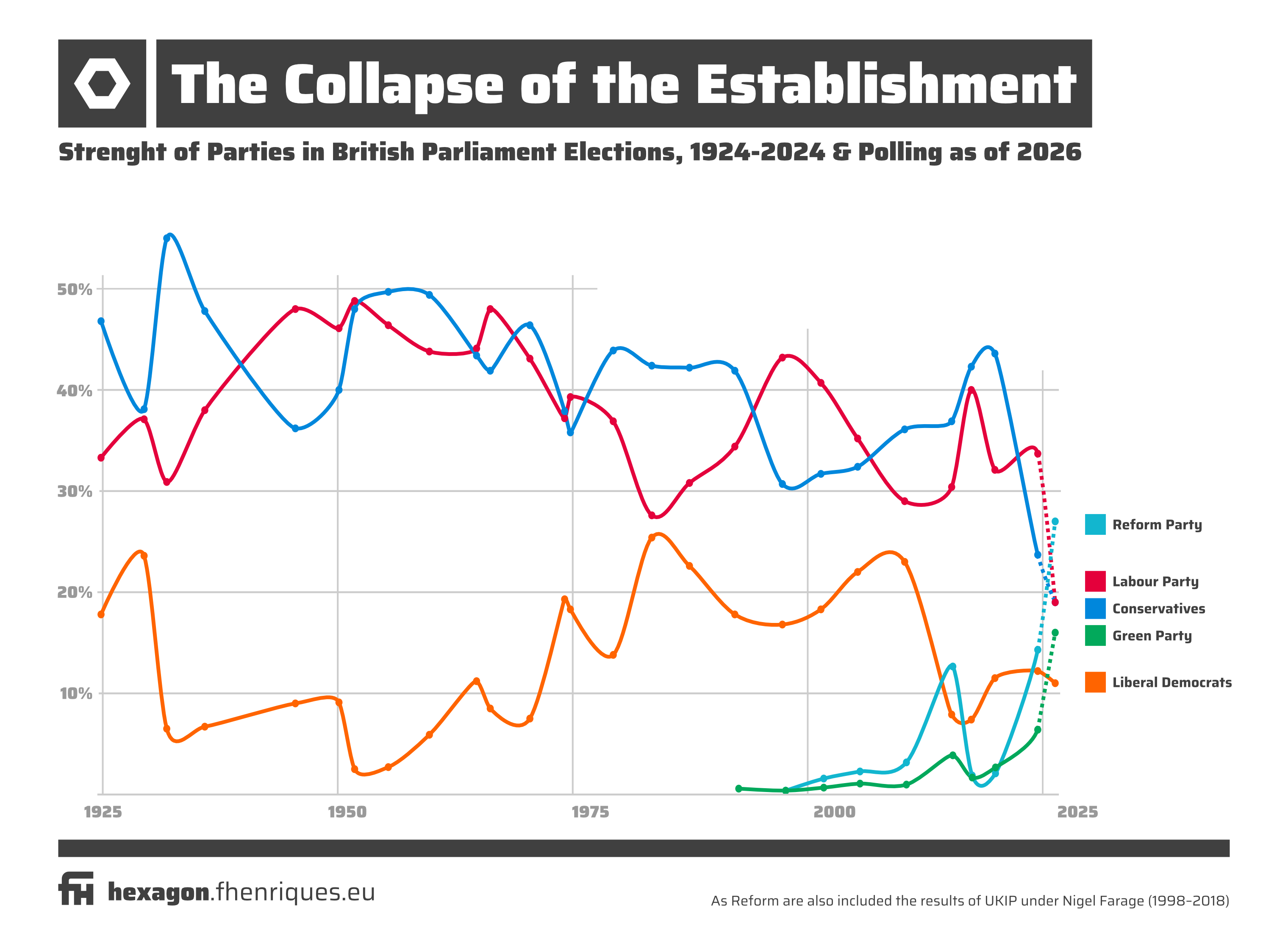
Last week people across the United Kingdom were called to vote, and they voted heavily for deepening the political crisis the country has been living in since 2016. If we project the results of the local elections onto national results, the far-right Reform would win with 26% followed by Greens, Conservatives, Labour and Liberal Democrats with around 17% each.
Keir Starmer is a particularly bad leader. His dishonesty and lack of values is difficult to compare with any other leader in Europe. Several ministers have resigned, a quarter of his parliamentary group have called for him to quit. Today - Wednesday - the King will go to parliament and deliver a speech, but it’s the Prime Minister’s head that is in danger of the (metaphorical) guillotine.
How did the UK get here? 2016 and the divorce with Europe.
The relationship of England with Europe has always been a difficult one. Winston Churchill, the father of modern Britain, was a fervent pro-European calling in 1946 for the creation of a United States of Europe. But he didn’t see England as part of Europe. For him the United States of Europe was a logical tool to bring the war-torn continent into peace and unity, but “[w]e British have our own Commonwealth of Nations”. This new Europe should, according to Churchill, have “France and Germany [...] take the lead together” and from the outside “Great Britain, [...] mighty America and [...] Soviet Russia” would be its “friends and sponsors”.
That is why the United Kingdom was not a part of the first steps that created the European Union, and only in 1963 - under Prime Minister Macmillan, a Conservative - did they apply to join for the first time. Charles de Gaulle, the true gaullist, vetoed the application. Then in 1967 - under Prime Minister Wilson, from Labour - they applied again, and Charles de Gaulle again vetoed it. De Gaulle believed that “Britain [is] incompatible with Europe” and that there was in London “deep-seated hostility” to European construction (ironically, from the man who embodied Parisian euroscepticism).
Then, Charles de Gaulle left the presidency of France in 1969, Britain applied for a third time, President Georges Pompidou ended the French veto, and in 1973 the United Kingdom became a member of the European Union.
Churchill and de Gaulle were right and, believe me, as a leftist it never pleases me to write that sentence. The “deep-seated hostility” never left London. Between Margaret Thatcher, John Major, Tony Blair, Gordon Brown and David Cameron, instead of making the case for Britain’s role in Europe, Downing Street always showed their contempt towards the continent. While playing with euroscepticism at home, and constantly stopping progress in Brussels, the legacy of Britain in the European Union was a constant negative antieuropean brake and its legacy is still felt across the continent, for example with the consequences of decades of political endorsement and financial support from the British Conservative Party to the main far-right parties from Poland, Italy, Denmark, Finland, Lithuania and Latvia, among others.
Britain left Europe. Now the rest of Britain is leaving England.
The decision in 2016 for the United Kingdom to leave the European Union felt like an earthquake. And since then, while the European Union not only survived but thrived away from British presence, the United Kingdom entered a decade of decline.
The success of Jeremy Corbyn in not only taking over the Labour Party, but achieving the best results for Labour since the height of Blairism even though he faced constant media and internal attacks, was the first warning sign that the 2016 earthquake was not at all about Europe. As everywhere else in Europe, COVID brought all this to a heightened level.
Now, millions of people in the United Kingdom were called to vote in local elections across England and national elections in Scotland and Wales. The results were what can be called a catastrophe to the establishment of British politics. Nigel Farage’s third iteration of a personalist party has conquered millions and made gains across the whole country. In Scotland and Wales the pro-independence parties have become the lead political force, and in big cities like London, Manchester, Birmingham, Glasgow, Newcastle, Edinburgh and Cardiff the Greens have made major gains.
With Northern Ireland having an Irish republican First Minister since 2021, now the other two peripheral nations of the United Kingdom will all be led by independence-minded leaders. In Wales the pro-independence center-left Plaid Cymru got their leader Rhun ap Iorwerth elected as First Minister, with the support of the Greens and the abstention of Labour and Liberal Democrats. Ap Iorwerth will lead a minority government, breaking 100 years of Labour domination in Wales. Meanwhile, up in Scotland the pro-independence SNP will continue to lead a minority government led by John Swinney, who can pick-and-choose any single party between Labour, Greens and Liberal Democrats to reach majorities.
England has been known as a two-party system for a long time, and structurally so. The combined vote share of Labour and the Conservative Party has been historically above 70% with seat share around 90%. The last decade has broken this. Already in the 2024 national election the combined result of the two mainstream parties was 57%, and if we translate last week’s result onto national results they would have 34%.
Declaring the end of the United Kingdom is a bit premature. Nigel Farage is nowhere near assured to become Prime Minister, with elections still far away. Scotland has no clear pathway to independence, with the British government rejecting any independence referendum potentially opening a constitutional crisis. And at one point the Labour Party might realise that keeping Starmer will be the death of their party.
Is Labour Dead? Long live the Greens?
Keir Starmer took over the Labour Party with one goal: kick out the left of the party and bring back a kind of Blairism that never even existed. His factionalism has kicked out most of the Left from the Labour Party, but that has meant also that Left voters - both working class socialists and younger leftists that were brought in by Corbyn - left too. On top of the internal machinations, Keir Starmer has stood strongly against anti-war and pro-Palestinian protests at the same time as he implemented orthodox austerity policies.
Labour is now bleeding both ways: to the far-right towards Farage’s Reform and to the left towards Zack Polanski’s Green Party. The rise of the far-right is universal at this point, so there’s little unique to it in Britain. But Zack Polanski’s Green Party is one of the few progressive parties in Europe that today is growing.
The Greens have managed to build on the failures of Labour, putting together a coalition of traditional Green voters like women and young urban voters, together with more traditional socialist voters from former Labour strongholds like working-class men and urban Muslim voters. They have done this not by changing their policies, but by focusing on the economy and affordability. All traditional Green topics like climate or inequality can be approached in a way that does not focus on urban niches, and Polanski is showing that.
But it’s not impossible that this is the lowest moment for Labour, and ahead there are better times. If Keir Starmer is kicked out and replaced by someone like Andy Burnham, Angela Rayner or even Ed Miliband, the Labour Party can recover some of the lost space. As an example, in the recent Gorton and Denton by-election that the Greens won, polling showed that if Andy Burnham had been the candidate he would have reduced the Reform vote by 15% and the Green vote by 60%. A new Prime Minister that implements proportional representation, brings down austerity and offers a clean break with the red conservatism of Starmer could offer a new life to the United Kingdom.