


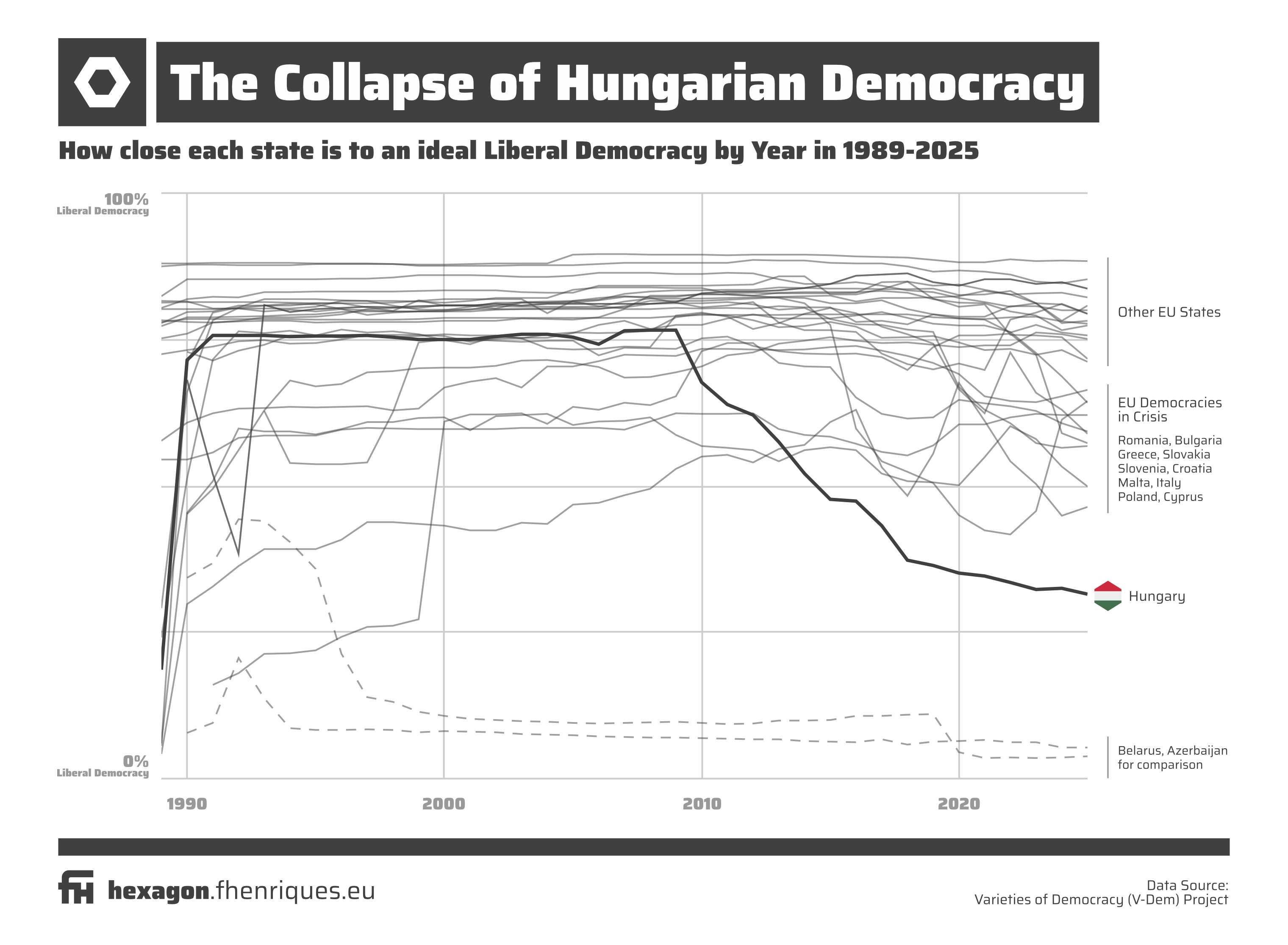
When Viktor Orbán first reached power he wasn’t the far-right darling we know today, quite the opposite. Orbán was a liberal reformist star, who challenged the Hungarian Communist regime and helped its collapse. His Fidesz party grew from single-digit support into leading a broad center-right coalition during the first decade of democracy.
Things started to change at the end of his first government. His coalition collapsed and began to rely on a far-right party for occasional support when needed. Internationally he moved Fidesz from the liberal family to the European People’s Party. Internally he started seeing Fidesz as not only the biggest party on the Right, but as the party capable of monopolising the Right. Heading into the 2002 elections, he gladly absorbed his coalition partners into Fidesz. Then he improved his results, became the biggest party in parliament, nonetheless got stopped by Socialists and Liberals forming a coalition.
Like many figures in the authoritarian Right, he learned lessons from his first time in government. Much like Trump or Netanyahu, he would come back stronger.
From 2002, Fidesz - now leading the opposition - became a populist party. The financial crisis of 2008 and the Őszöd scandal helped him greatly. In 2010 he returned to power, this time with a two-thirds majority in parliament. He radicalized further and changed the constitution without public debate. Fidesz monopolized power and became Europe’s first far-right government. The independence of the judiciary and of the media would later become victims.
Péter Magyar: dismantler or heir to Orbán’s regime?
The “illiberal democracy” that Orbán proclaimed in 2014 had one problem: you can tilt the rules in your favour all you want, but ultimately the only way to guarantee power is violence. Orbán made sure to build his autocratic state but, this Sunday, the Hungarian people were finally offered a clear alternative and mobilized in historical numbers to kick Orbanism out. The scale of the mobilisation made it impossible for Orbán to even try to claim power.
The Orbán regime has fallen. But the autocratic architecture remains in place. Péter Magyar - the prime minister-elect - will be, on day one, the leader of an autocratic regime and will be up to him to dismantle it, knowing that at each step of that process he brings himself closer to losing power.
The pressure on Magyar must be maximal, yet progressives are now not only absent from the Hungarian Parliament but also marginal in the political landscape.
The challenge is enormous, and the EU won’t be much help either. Given today’s right-wing dominance of European institutions, Magyar’s support for Ukraine and the lifting of the constant vetoes will be enough to grant support from the EPP and its right-wing allies. Magyar can become an Eastern Meloni and Von der Leyen will be the first one to applaud.
The European People’s Party is key in this story. The EPP was the home of Fidesz for many years and is now the home of Péter Magyar. In the last decade, and especially under the leadership of Manfred Weber, the EPP seeks power for power’s sake, and has no problem if democracy is a victim of it. In Hungary it only broke with Fidesz and Orbán when the illusion of Péter Márki-Zay seemed like an alternative to power. In countries like Greece, Slovenia, Bulgaria or Croatia it is still the EPP that leads the destruction of liberal democracy.
Eastern Far-Right Keeps Growing
The legacy of Orbán is also the destruction of the progressive camp. The new Hungarian Parliament has zero liberals, zero social democrats, zero Greens, zero leftists. Hungary has become a two-party system by necessity, and that has meant the progressives had to fall in line with the conservatives. But this extreme weakness of the progressive camp is not a Hungarian phenomenon.
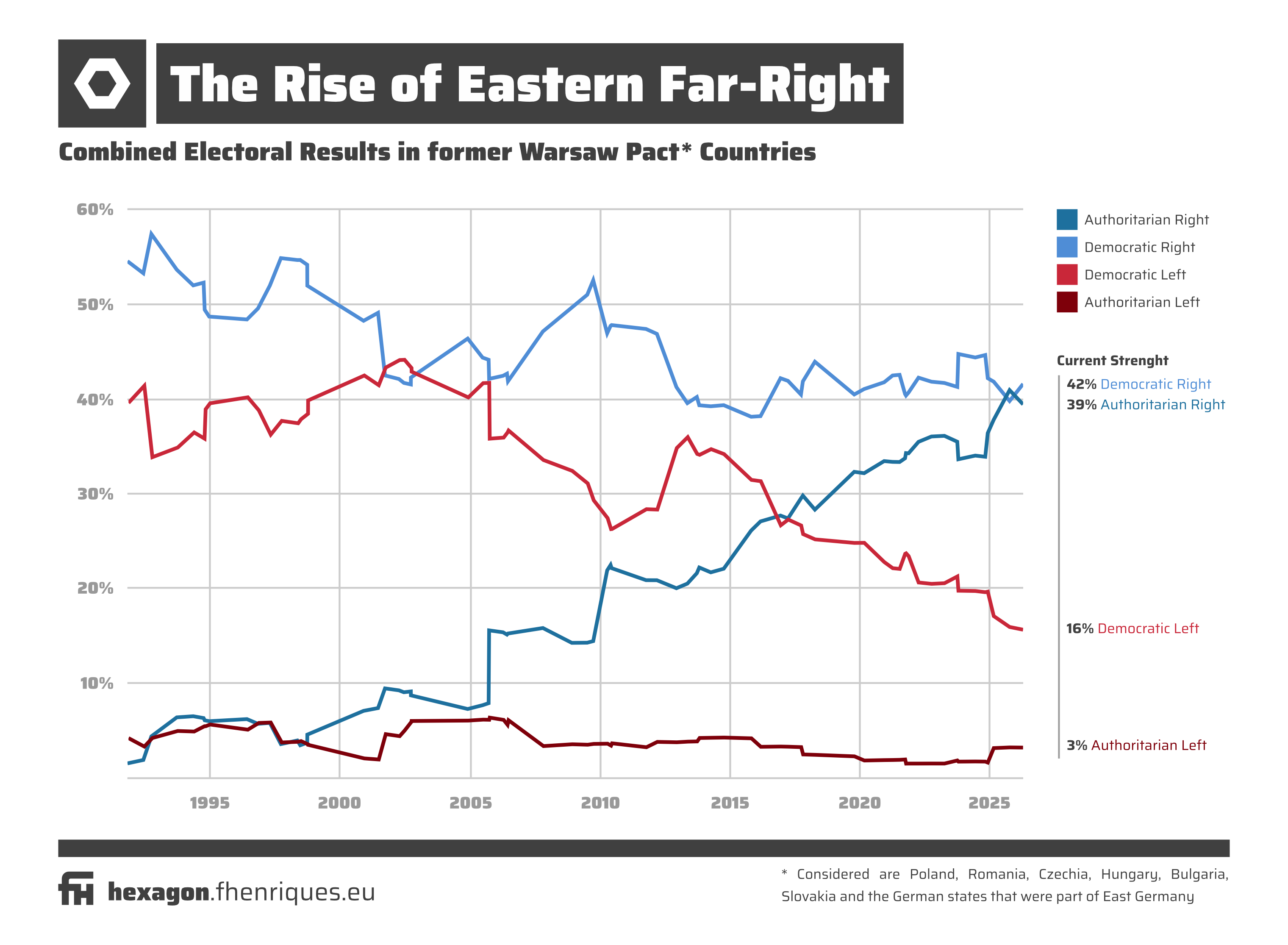
If we look at the old Warsaw Pact countries, a region that spans from the Baltic Sea to the Black Sea, going through Poland, East Germany - and later the eastern states of Germany, - Czechia, Slovakia, Hungary, Romania and Bulgaria, we have a region of more than 100 million citizens, or around one quarter of the entire European Union.
Since the return to democracy in the early 90s, the authoritarian Right has constantly grown all over the region. While in Western Europe the growth of the far-right is mostly a newer and more intense phenomenon, in this part of Eastern Europe it has been a steady growth over the years. Part of this has also been the radicalization of specific political parties, like Hungary’s Fidesz or Poland’s Law and Justice who bega gathering support while being democratic parties and then evolved into far-right parties later.
The authoritarian Right has lost its poster-boy in Hungary, just two years after losing control of Poland, yet they are not defeated. Across post-Warsaw Pact Europe, 39% of voters support authoritarian right-wing parties, while 40% vote within the democratic Right camp - including Conservatives, Christian-democrats and Liberals. Altogether, the Right has 80% of the electorate.
The broad Left gets less than 20% of the vote, with half of it being traditional social democratic parties, a third being other left-of-center parties - including Greens and leftists - and the remainder are authoritarian left-wing parties like Slovakia’s Smer or remnants of Eastern communist parties.
Across the whole region the choice is between authoritarians and the democratic Right. Progressives are merely an accessory. Parties like Nowa Lewica or Razem in Poland or Piráti in Czechia are themselves forced to cooperate with the right-wing to guarantee democracy and basic rights while making it impossible for them to push for more progressive policies or gain from being in government. A strong election result means being locked into government with conservatives, which in turn demobilises the progressive electorate and leads to weaker results next time.
This disappearance is obviously, from a progressive standpoint, negative for these countries and for the people in them. It’s also objectively bad for democracy: if the Overton window has been pushed so much to the right that the only difference between parties is democracy, then it’s democracy that is at risk. But it’s deadly for progressives in the whole of Europe: with zero strength in Eastern Europe, there is no path to a future progressive majority in the European Union.
Now, Bulgaria Votes Again.
Bulgaria goes to the polls this weekend, and I can’t blame anyone who isn’t paying much attention. I’ll be honest, I also wasn’t. The country has been in a deep political crisis since 2021, when popular mobilisations brought down the corrupt government of Boyko Borisov and his populist GERB party, an EPP‑member, which governed the country for most of the last 12 years. The election that followed renewed the parliament, with 40% of MPs coming from new parties of differing ideologies claiming to bring the demands from the streets into parliament.
The political fight between the old parties and the parties of change made stable coalitions impossible, and in the last five years the country has held eight parliamentary elections and seen ten governments.
This Sunday, finally, a major change might deliver a government. The popular Rumen Radev who was until now President of Bulgaria elected with a two-thirds majority and with the support of the parties of change and the BSP, resigned as President and formed his own political party. Polls show his party as the most popular force reaching up to 100 MPs, and being able to choose any of the other parties as allies.
As we’ve seen repeatedly, the problem with personalist parties based around a strong leader is that they are malleable to the ideas the leader chooses at any given moment. Rumen Radev benefits from his independence: since the end of Communism he has never been a member of a political party, he was supported by the Bulgarian Socialists to reach the presidency but never joined them, and has openly opposed all parliamentary parties at various points during his term. He has been the arch-enemy of Boyko Borisov, and criticised his corruption giving him the mantle of anti‑corruption. At the same time he has supported anti-refugee policies, taken softer‑on‑Russia positions and pushed for a harder Bulgarian line against North Macedonia. His new party - misnamed Progressive Bulgaria - draws support from VMRO, the traditional far-right party which left parliament in 2021.
As we celebrate the end of Orbán, Bulgaria goes back to the polls and even after seeing the results on Sunday it might still be hard to grasp what the results actually mean. It could be a reformist government that restores stability, with a majority of Progressive Bulgaria and the liberal coalition PP‑DB. Or it could be a left-nationalist majority of Progressive Bulgaria and the BSP, which mirrors Slovakia’s government, and establishes another headache for European support for Ukraine. Or it could simply be another election whose only result is the scheduling of a new vote in a few months.
There's a sentence that has hit me hard, not because I was not aware, but because how clearly it's stated: "With zero strength in Eastern Europe, there is no path to a future progressive majority in the European Union."
My takeaway is that any progressive in Europe should be interested in developing progressive ideas all over Europe, especially in Eastern Europe.